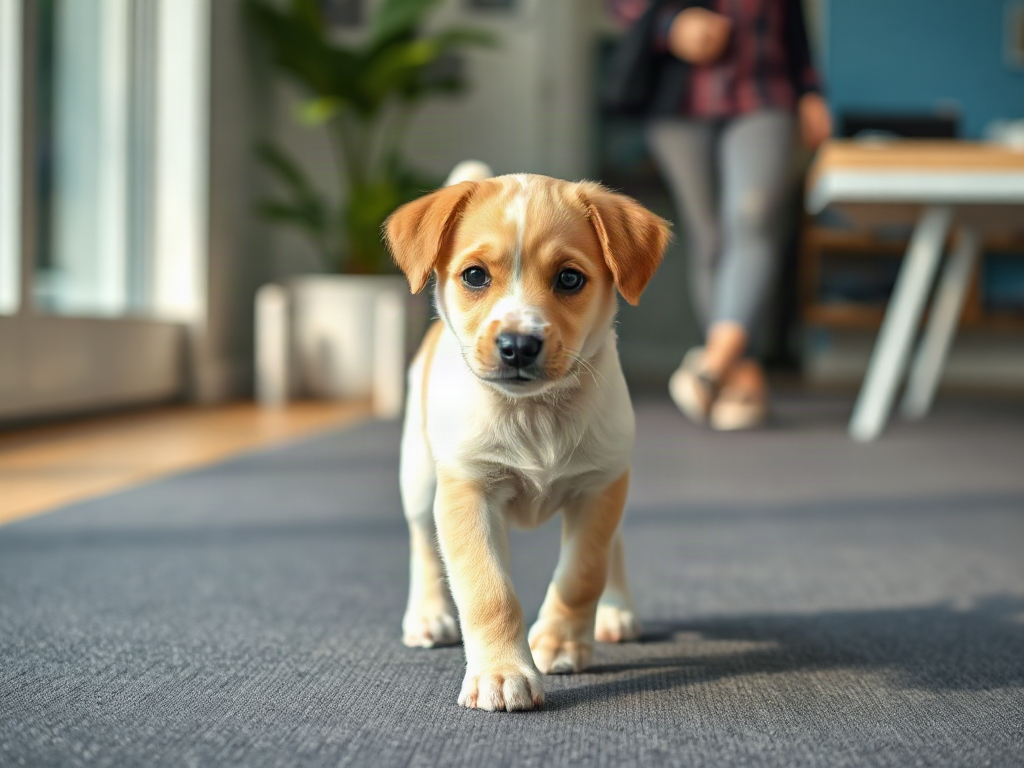
Train a puppy to heel on a leash by rewarding the puppy beside your chosen leg, taking only a few steps at first, and marking the correct position before the leash becomes tight. Practice indoors with small treats, a comfortable harness or collar, and a short cue such as “heel,” then gradually add distance, turns, and mild outdoor distractions. Stop moving if the puppy pulls ahead, but avoid jerking the leash or forcing continuous eye contact. Keep heel sessions brief and separate them from relaxed sniffing walks so the puppy learns that heel means a precise position rather than the only acceptable way to walk.
Define the Heel Position and Prepare the Equipment
A useful heel is a specific walking position, not merely the absence of pulling. The puppy’s shoulder should remain roughly aligned with your leg on one chosen side, while the leash hangs with visible slack. The puppy does not need to stare at you continuously. Attention should be sufficient for the puppy to notice changes in your pace and direction without losing awareness of the surroundings.
Choose the left or right side before practicing and remain consistent during the early stages. Traditional obedience often places the dog on the handler’s left, but either side can work for everyday walking. Your normal route, physical mobility, and the side on which you carry treats may influence the choice. Switching sides randomly makes the target position harder to predict, whereas deliberately teaching a separate cue for each side can be useful later.
Use a standard fixed-length leash rather than a retractable leash during heel practice. A retractable line changes tension as the puppy moves, which can reward forward pressure and blur the distinction between slack and pulling. Attach the leash to a properly fitted flat collar or body harness that does not restrict shoulder movement. Check that the puppy cannot back out of the equipment. A harness may be preferable for a puppy that surges suddenly, but equipment alone does not teach position; the reward placement and walking pattern do that.
Prepare pea-sized, easy-to-swallow treats and hold them on the same side where the puppy will heel. Delivering food across your body can draw the puppy in front of your knees or cause sideways weaving. If ordinary kibble is sufficiently valuable indoors, reserve richer food for outdoor practice where smells and movement compete for attention. Account for training food within the puppy’s daily intake rather than adding large quantities without adjustment.
Heel work should not replace age-appropriate exploration. A precise position requires sustained concentration, while sniffing and investigating provide a different kind of enrichment. Use a clear release cue, such as “free,” when the puppy may leave your side to sniff on a loose leash. Separating these activities gives “heel” a narrow, understandable meaning. Before following detailed instructions for how to train a puppy to heel on a leash, confirm that your puppy can comfortably wear the equipment and accept treats outside the home.
Teach the Position Before Adding Distance
Stationary position work gives the puppy a clear answer before walking introduces speed and competing choices. Begin in a quiet room or fenced private area. Stand naturally, lure or invite the puppy beside the selected leg, and mark the moment the shoulder reaches the correct location with a clicker or a brief word such as “yes.” Deliver the treat directly beside your trouser seam rather than out in front.
Repeat the setup from slightly different starting points. If the puppy approaches from in front, guide the nose in a small arc so the body turns into alignment rather than stopping diagonally across your path. Fade the food lure after several successful repetitions: make the same hand movement with an empty hand, mark the completed position, and then reward from the other hand or a treat pouch. Keeping food permanently at the puppy’s nose can create following without teaching an independent response.
Once the puppy can find the position, say “heel” immediately before inviting the movement into place. The cue should predict an action the puppy already understands; repeating it while the puppy wanders does not make its meaning clearer. Reward one second of standing beside you, release the puppy, and reset. Then add movement in very small increments:
- Take one step. Mark while the puppy remains beside your leg and feed in position.
- Take two or three steps. Reward before attention drifts or the leash tightens.
- Vary the reward point. Sometimes pay after one step and sometimes after several, provided the position stays accurate.
- Add the release. End the repetition while the puppy is still succeeding.
Early sessions can last one to three minutes and occur several times across the day. Young puppies often perform better with these brief repetitions than with one prolonged drill. If accuracy declines, reducing distance is usually more productive than showing the puppy another treat and continuing. A puppy that can manage three neat indoor steps has learned more useful information than one that follows food for an unfocused circuit of the room.
Reward timing determines what the puppy believes earned the food. Mark while the shoulder is aligned, not after the puppy has moved ahead and turned back. Feed low and close to your leg so the puppy remains in place for the next repetition. A practical account of how to train a puppy to heel on a leash therefore depends less on covering distance than on making each successful position easy to identify.
Build a Reliable Heel With Turns and Distractions
Distance, duration, and distraction should increase separately whenever possible. A puppy that can heel across a quiet kitchen may not yet understand the behavior beside a moving bicycle, another dog, or a patch of interesting grass. Outdoor failure often reflects a training jump rather than stubbornness. Move first to a hallway, driveway, quiet yard, or low-traffic pavement before expecting the same precision on a busy route.
Use changes of direction to teach the puppy to monitor your movement. Begin a gentle turn before the leash tightens, mark when the puppy catches the new line beside you, and reward after the turn. Left turns require the puppy to slow and move with your leg; right turns require a little acceleration. Wide curves are easier than abrupt pivots, particularly for a physically immature puppy whose coordination is still developing.
Pace changes add the same skill without requiring a long route. Walk five normal steps, slow for two, then return to your normal speed. Reward the puppy for adjusting while maintaining alignment. Brief halts can teach an automatic stop beside your leg, but decide whether you want a stand or sit at halts and reinforce that response consistently. Formal sits are optional for household leash manners.
When introducing a distraction, create enough distance for the puppy to notice it and still eat, respond to the cue, and move with you. For example, if a puppy can heel at 30 feet from a calm dog but lunges at 10 feet, practice outside the failing distance rather than repeatedly approaching until control disappears. Reward several short passes, then leave. Distance is a training tool, not an admission that the puppy will never cope at closer range.
Signs of suitable difficulty include a slack leash, quick recovery after looking away, and the ability to take food without grabbing frantically. Repeated scanning, refusal of normally valued food, vocalizing, freezing, or surging suggests the environment is too demanding. Move farther away, shorten the repetition, or return at a quieter time. Trying to overpower high arousal with leash pressure can associate the trigger with discomfort while doing little to teach heel position.
Do not fade rewards simply because the puppy has performed well for a few days. Shift gradually from rewarding nearly every correct step to rewarding short clusters of good movement, clean turns, and voluntary check-ins. Real-life rewards can also follow a successful repetition: ask for five heel steps, release the puppy, and allow access to a safe sniffing spot. That arrangement makes environmental access contingent on cooperation without expecting an entire walk at heel.
Correct Pulling, Lagging, and Other Heel Problems
Pulling should stop forward progress without turning the session into a contest of strength. If the leash becomes tight, pause or change direction smoothly, then mark and continue when the puppy returns beside you. The consequence is clear: pressure does not produce forward travel, while slack and position do. Avoid snapping the leash, dragging the puppy backward, or maintaining steady tension, all of which can prompt opposition or make the walking equipment unpleasant.
A puppy that repeatedly races ahead may be working for rewards delivered too far forward. Move the feeding point back beside your leg and reward sooner, before acceleration begins. The environment may also be too exciting for sustained heel work. Ask for two or three successful steps, release for controlled exploration, and repeat after the puppy has had a chance to investigate. Expecting precision immediately after leaving the front door is harder than practicing later in the walk, once initial excitement has eased.
Lagging requires a different response. First check for heat, fatigue, frightening surfaces, poorly fitted equipment, or physical discomfort. Puppies should not be pulled forward to meet a training target. In a comfortable setting, use an upbeat pace, move away a step, and reward the puppy for catching up beside your leg. If slowing, reluctance, limping, or unusual sitting persists, stop the session and seek veterinary advice rather than treating the change as disobedience.
Jumping at the treat hand usually means the food is visible too long or delivered too high. Keep the hand neutral between rewards, mark four paws on the ground in heel position, and bring the treat down to the puppy’s mouth. Biting or grabbing the leash may signal overexcitement, frustration, or fatigue. Shorten the exercise and offer an appropriate toy after the repetition instead of tugging back on the leash.
Use this compact check when progress stalls:
- Position: Is the reward landing beside your leg rather than ahead of it?
- Difficulty: Did distance, duration, and distraction increase at the same time?
- Leash: Is slack present, or are both handler and puppy maintaining tension?
- Condition: Is the puppy rested, comfortable, and able to take food normally?
- Criteria: Are you rewarding a defined heel rather than any movement near you?
Progress is rarely linear during adolescence, environmental changes, or growth-related coordination shifts. Measure improvement by the puppy’s ability to regain position, handle slightly more distraction, and complete short repetitions with less frequent prompting. If the puppy shows persistent fear, intense reactivity, or distress around the leash, personalized help from a qualified reward-based trainer or veterinary behavior professional is more appropriate than increasing corrections. A careful approach to how to train a puppy to heel on a leash protects both mechanical skill and the puppy’s willingness to walk with you.
Frequently Asked Questions
At what age can a puppy begin learning to heel?
A puppy can practice the position soon after becoming comfortable with a collar or harness and leash. Keep repetitions brief, use low-distraction spaces, and avoid demanding long periods of precise walking from a young puppy.
Should a puppy heel on the left or right side?
Either side is suitable for everyday walking. Choose the side that fits your handling needs and reward it consistently; teach a second side later with a distinct cue if that flexibility would be useful.
How long should each heel session last?
Start with one to three minutes of focused work, often divided into several tiny repetitions. End when position is still accurate rather than continuing until the puppy becomes distracted, tired, or frustrated.
Should I stop every time my puppy pulls?
Pause or change direction whenever tension begins, then resume when the puppy returns and the leash softens. Consistency matters, but use easier surroundings and shorter repetitions if you are stopping every few seconds.
Does my puppy need to heel for the entire walk?
No. Reserve heel for road crossings, crowded areas, passing distractions, or short practice intervals. Use a release cue for safe loose-leash exploration so the puppy can sniff without confusing it with heel work.
Conclusion
A dependable heel develops from accurate reward placement and manageable repetitions, not from holding the leash short enough to keep a puppy nearby. Establish one clear side indoors, reinforce the shoulder beside your leg, and add steps only while the leash remains loose. Introduce turns, pace changes, and outdoor distractions one layer at a time, using distance whenever excitement or uncertainty disrupts learning.
For the next session, choose a quiet location and practice five short setups followed by several one- to three-step repetitions. Release the puppy before concentration fades. If pulling or lagging appears, inspect the reward point, surroundings, equipment, and physical comfort before increasing pressure. The practical goal is a puppy that understands where to walk and can return to that position willingly when the heel cue matters.