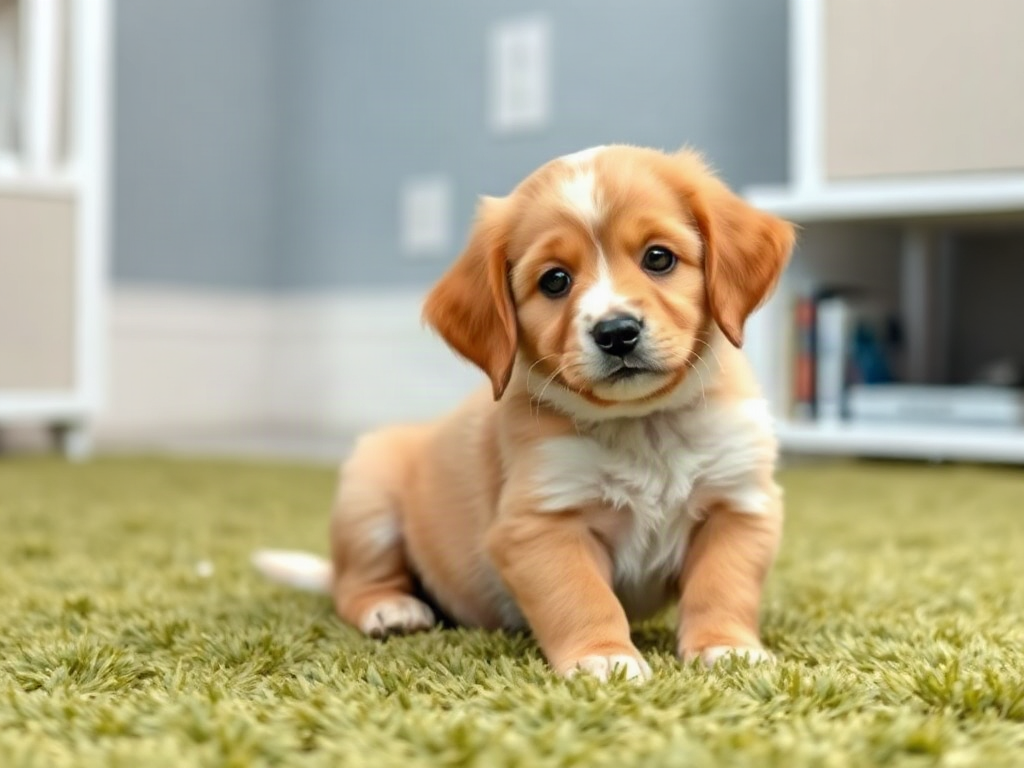
Deal with puppy potty accidents indoors by interrupting calmly if you catch one, taking the puppy to the designated toilet area, rewarding outdoor elimination, and cleaning the indoor spot with an enzymatic cleaner. Do not punish the puppy or rely on ordinary household cleaners, because fear can encourage hidden elimination and lingering odor can draw the puppy back. Prevent repeats with close supervision, a schedule built around waking, meals, play, and confinement, plus a written accident log. Contact a veterinarian when accidents increase suddenly or occur with straining, frequent urination, diarrhea, unusual thirst, pain, or lethargy.
What to Do During and Immediately After an Accident
Your response should depend on whether the accident is in progress or already finished. If you see your puppy beginning to squat, interrupt with a neutral sound and promptly carry or guide the puppy to the usual outdoor toilet area. Keep the interruption calm enough that it stops the action without frightening the puppy. If elimination continues outside, reward it immediately after the puppy finishes.
If you find urine or stool after the fact, say nothing to the puppy. Dogs do not connect delayed punishment with an earlier bodily function in the way an owner may assume. Pointing at the mess, scolding, or rubbing a puppy’s nose near it can instead make elimination around people feel unsafe. The result may be a puppy that slips behind furniture or waits until nobody is watching rather than one that understands where to go.
Move the puppy to a secure supervised area while you clean. For urine, blot rather than scrub at first, because scrubbing can spread moisture deeper into carpet fibers and padding. Pick up solid waste, remove any residue, and use a cleaner intended to break down pet-waste odor. Keep the puppy away until the surface is dry and the product’s label says the area is safe to use again.
Timing matters more than intensity. A reward delivered outdoors within a moment of finishing clearly identifies the desired location; praise offered after everyone has returned inside may reward coming through the door instead. Use a small food reward that can be swallowed quickly, then allow a brief sniff or a little outdoor freedom. That extra outdoor time prevents another common problem: puppies that delay elimination because they have learned that urinating makes the outing end.
When an accident occurs during a busy moment, record when it happened and what came before it. A note such as “3:20 p.m., ten minutes after vigorous play” is more useful than labeling the puppy stubborn. For a fuller approach to how to deal with puppy potty accidents indoors, treat each incident as information about timing, access, and supervision rather than as disobedience.
Why Indoor Accidents Keep Happening
Repeated accidents usually indicate that the puppy had too much freedom, missed a timely outing, did not fully empty outside, or has not yet generalized the toilet rule to every room. Young puppies have developing bladder and bowel control, but age alone cannot produce a precise schedule. Drinking, eating, activity, sleep, excitement, stress, and individual health all affect urgency.
Look first at what happened during the preceding hour. A puppy that wakes from a nap, drinks, races around the kitchen, and then urinates beside the table was given several strong triggers without a toilet break. An accident at the same time each evening may follow dinner or energetic play. An accident shortly after an outdoor trip may mean the puppy was distracted, the outing ended too quickly, or the owner mistook sniffing and exploring for completed elimination.
Location also provides clues. Repeated use of one carpet corner suggests residual odor, easy access, or a learned surface preference. Accidents near the exit may mean the puppy recognized the need but could not wait for the door to open. Scattered small urine spots can reflect excitement, marking, incomplete emptying, or a medical concern; they should not automatically be treated as a routine house-training lapse.
Indoor pads create a practical tradeoff. They can be useful when outdoor access is genuinely limited, such as in a high-rise building or during unsafe weather, but they also teach that elimination on an indoor absorbent surface is acceptable. If the long-term goal is outdoor toileting, keep any pad in one stable location and transition deliberately rather than scattering pads around the home. Rugs, bath mats, and blankets may otherwise resemble the approved surface.
A compact accident log can separate patterns from guesses. Track:
- Time and type: urine, stool, or both.
- Recent events: waking, food, water, play, excitement, or confinement.
- Last successful trip: when it occurred and whether elimination was observed.
- Location and surface: carpet, hard floor, bedding, doorway, or crate.
- Physical signs: straining, loose stool, unusual thirst, or repeated attempts.
Review the notes after several days. A predictable interval calls for an earlier outing; random accidents despite attentive supervision deserve closer scrutiny. The weak assumption is that a puppy “knows better” after a few successes. Puppies often learn context narrowly, so success in the kitchen does not prove that an upstairs bedroom carries the same rule.
Removing Odor Without Reinforcing the Toilet Spot
Effective cleanup must remove the waste humans can see and the scent the puppy can still detect. Urine may soak through carpet into the underlay, enter seams between floorboards, or collect around the base of furniture. A surface that smells clean to a person can continue to act as a toilet cue for a dog.
Use an enzymatic pet-accident cleaner that is labeled for the affected material. These products are designed to break down organic residue rather than merely cover it with fragrance. Follow the manufacturer’s directions for saturation, contact time, ventilation, and drying. Applying too little to a deep carpet stain may clean the fibers while leaving contaminated padding below. Mixing products is not a stronger approach and may damage the surface or create unsafe fumes.
Fresh urine on carpet should be blotted with absorbent material before cleaner is applied. On sealed hard flooring, wipe up liquid promptly and clean the joints as permitted by the flooring manufacturer. Upholstery, unfinished wood, natural stone, and washable bedding require material-specific care; test any cleaner in an inconspicuous area. Launder machine-safe items according to both the fabric label and cleaner instructions, and do not return them while an odor remains.
Steam cleaning is not always the best first response to a urine spot. Heat may set odor-bearing material into some fibers, while an unsuitable machine can spread contamination over a larger area. Enzymatic treatment followed by extraction, when compatible with the surface and product directions, is often more targeted. A heavily contaminated rug pad or porous item may need professional treatment or replacement if repeated cleaning fails.
After cleaning, temporarily block access to a favored accident site or change how the area is used. Place a puppy bed, supervised play station, or piece of furniture there only after the material is fully clean and dry. Blocking alone does not solve the underlying schedule problem, but it prevents rehearsal while the new outdoor habit develops. Avoid ammonia-based products unless specifically directed for the surface and pet waste; ammonia-like odors may resemble components of urine to a dog.
If the puppy returns to one location, reassess both odor removal and supervision rather than adding stronger fragrance. The practical test is whether the area remains odor-free after drying and whether the puppy stops investigating it during supervised access. Continued intense sniffing, circling, or revisiting means access should remain restricted while cleanup and the toilet schedule are reviewed.
Resetting the Potty Routine and Preventing Repeats
A reset works by reducing unsupervised choices and creating more opportunities to succeed outdoors. For several days, take the puppy out immediately after waking, after meals or substantial drinking, after active play, before confinement, after release from confinement, and before bedtime. Add trips before the times identified in the accident log instead of waiting for visible urgency.
Use the same accessible toilet area when practical. Stand quietly and allow enough time for the puppy to settle rather than turning every outing into play. A consistent verbal cue can be spoken softly as elimination begins, but repeating the cue while the puppy is distracted does not teach its meaning. Reward only after completion so the puppy does not stop midway to collect food.
Supervision must be active. A puppy loose in another room is not supervised merely because an owner is home. Keep the puppy in the same room, use gates to limit access, or attach a lightweight leash to an attentive adult where it can be managed safely. Watch for abrupt disengagement from play, floor sniffing, circling, wandering toward a previous spot, or moving out of sight. Those behaviors justify an immediate trip outside.
Crates and pens can support a schedule, but they should not be used to test how long a puppy can hold waste. The space must be suitable for rest, introduced positively, and paired with prompt toilet access. A crate that is too large may allow separate sleeping and toilet areas; confinement that lasts beyond the puppy’s capacity can force soiling and undermine comfort with the crate. If accidents happen during confinement, shorten the interval and evaluate whether distress, loose stool, excessive drinking, or a health issue is involved.
Expand freedom based on observed reliability, not on a fixed number of accident-free days. Start with one easy-to-monitor room. When the puppy consistently signals, eliminates during scheduled trips, and does not search for indoor sites, add access gradually. If accidents return after expansion, reduce the area without punishment and rebuild success. This is more effective than leaving the whole home open and repeatedly reacting after the puppy disappears.
Everyone in the household should use the same exit, reward timing, and supervision rules. Mixed handling—one person rewards outside while another scolds indoor mistakes—creates avoidable uncertainty. Keep treats by the exit, assign outings during busy periods, and record successful elimination as well as accidents. Consistency is central to how to deal with puppy potty accidents indoors because the puppy learns from repeated location-and-consequence patterns, not from verbal explanations.
When Accidents May Need Veterinary Attention
A sudden change in a previously reliable puppy deserves more attention than an occasional mistake during early house training. Urinary or digestive problems can reduce control, increase urgency, or make elimination painful. Behavioral management may limit messes, but it cannot identify or resolve an underlying medical cause.
Contact a veterinarian promptly if accidents occur with straining, crying, blood, repeated attempts that produce little urine, frequent urination, vomiting, diarrhea, lethargy, reduced appetite, unusual thirst, or discomfort. Inability to pass urine can be urgent and should not be watched at home while attempting a schedule reset. Puppies can also become dehydrated more quickly than adult dogs when vomiting or diarrhea is present, so timely professional advice matters.
Bring useful observations rather than a conclusion. Note the puppy’s age, normal routine, when the change began, frequency and volume of elimination, stool appearance, appetite, water intake, medications, diet changes, and possible access to unsafe substances. A photo of abnormal stool or a veterinarian-requested sample may be helpful, but follow the clinic’s collection and storage directions.
Excitement urination and submissive urination can look different from an ordinary full-bladder accident. Small releases during greetings, looming approaches, or highly stimulating interactions may improve when greetings become quieter and people avoid bending directly over the puppy. Punishment tends to worsen fear-related leakage. Even so, a veterinarian should first help rule out physical causes when the pattern is new, frequent, or uncertain.
Progress should look like longer stretches of appropriate elimination, fewer attempts to revisit indoor sites, and more predictable behavior around scheduled outings. Failure looks like rising frequency despite tighter management, accidents during sleep, discomfort, unusually large or tiny urine amounts, persistent loose stool, or no relationship between accidents and routine. Those signs justify professional assessment rather than stricter correction.
Frequently Asked Questions
Should I punish my puppy for peeing in the house?
No. Punishment after an accident does not clarify the correct location and may teach the puppy to eliminate out of sight. Clean the area, increase supervision, and reward the next outdoor success immediately.
What should I do if I catch my puppy having an accident?
Interrupt without shouting, take the puppy directly to the designated toilet area, and reward if elimination finishes there. Avoid startling the puppy so severely that elimination around you becomes frightening.
Why does my puppy pee indoors right after going outside?
The puppy may have been distracted, may not have emptied fully, or may have learned that toileting ends outdoor time. Use a quiet toilet spot, confirm elimination, reward it, and allow a short period outside afterward.
What cleaner should I use for puppy urine?
Choose an enzymatic pet-accident cleaner approved for the affected surface. Blot fresh urine, apply enough product to reach soaked material, and follow label directions for contact time, ventilation, and drying.
When should indoor accidents concern me?
Seek veterinary advice for a sudden increase or accidents accompanied by straining, blood, frequent attempts, unusual thirst, pain, lethargy, vomiting, or diarrhea. An inability to pass urine may require urgent care.
Conclusion
Indoor accidents become easier to manage when each one is treated as evidence rather than defiance. Clean deeply enough to remove the scent cue, protect the area from another visit, and identify what preceded the incident. Then tighten supervision and schedule outings around waking, meals, drinking, play, and confinement instead of relying on the puppy to signal reliably.
Judge progress through patterns: more successful outdoor trips, fewer returns to old spots, and predictable dry periods. If freedom was expanded too quickly, reduce it temporarily and rebuild one room at a time. Persistent accidents, abrupt regression, discomfort, or changes in urine, stool, thirst, appetite, or energy require veterinary input. The next practical step is to start an accident-and-success log today, place suitable cleaner within reach, and plan the puppy’s next several toilet trips before urgency appears.